
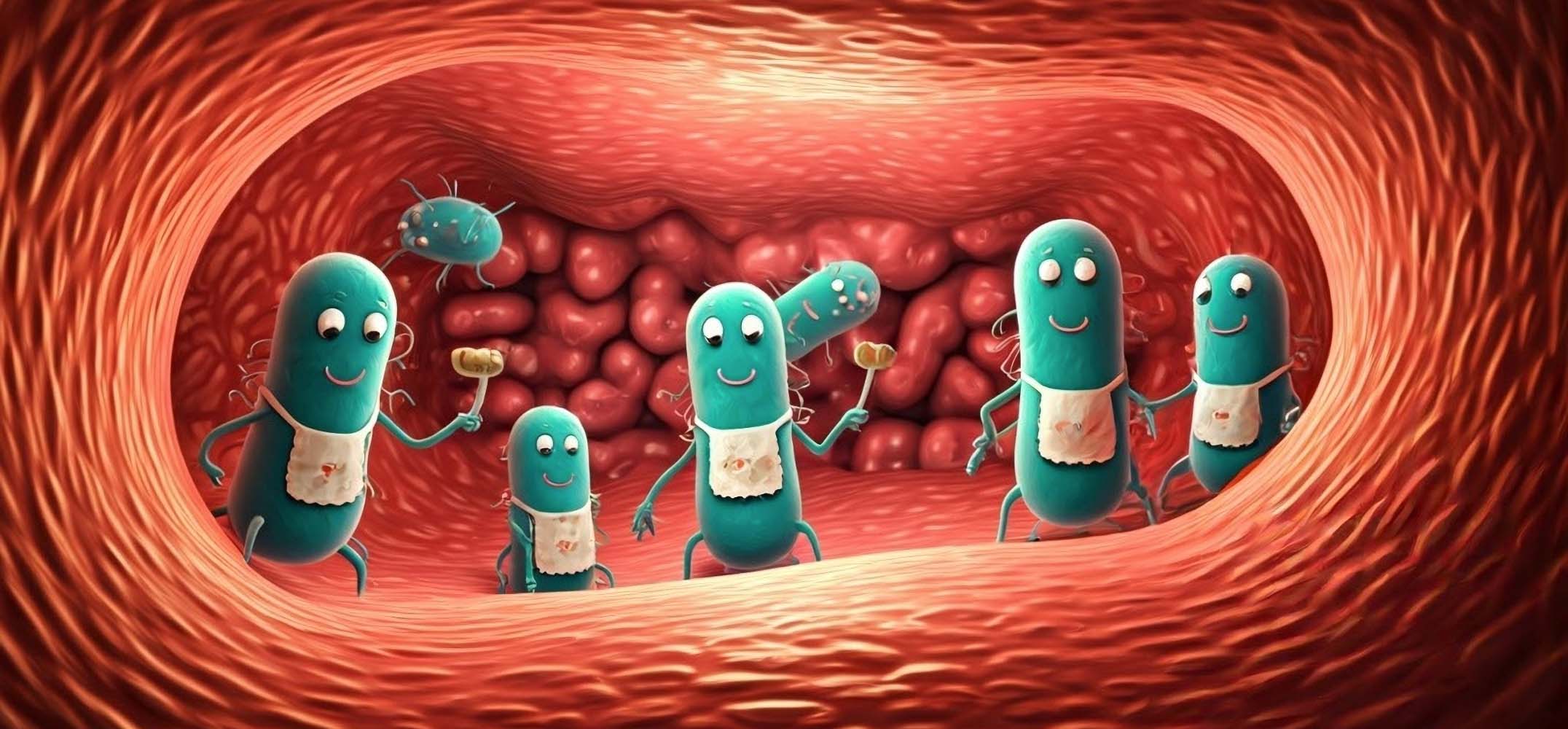
Gut health is a major focus in modern nutrition science. This is because the gut plays a huge role in your immunity, nutrient absorption, metabolism and communication with the rest of the body. That’s why interest in the gut microbiome has grown so rapidly.
Among the trillions of microbes that live in the gut, certain species appear to play a more specialised role in supporting gut function and metabolic signalling. If you’ve been hearing more about Akkermansia muciniphila it’s because this unique gut bacterium has shown incredible gut barrier function, metabolic signalling and microbiome health, with human clinical research to support its role. It’s also one of the few so-called “next-generation” gut microbes to be studied in supplement form.
Where is Akkermansia muciniphila found?
Akkermansia muciniphila is a natural resident of the human gut and was first isolated in 2004, when researchers began identifying microbes that interact directly with the gut’s protective mucus layer. In healthy adults, Akkermansia is estimated to make up around 1-3% of the total intestinal microbiota. While that may sound like a small proportion, its location gives it an outsized influence.
Rather than floating freely in the gut, Akkermansia lives in the mucus layer of the large intestine (colon), right next to the gut lining. The mucus layer is the gut’s “protective gel coating” or a physical barrier that helps separate the body from the contents of the digestive tract. Here’s what makes Akkermansia unique:
- It feeds on mucin, the main building block of this mucus layer
- In response, the body produces more mucin
- This helps maintain a strong, healthy gut barrier
This discovery reinforced a now well-established concept in nutrition science: the gut microbiota plays an important role in maintaining human health by influencing metabolism and gut barrier function.
In population studies, people with higher levels of Akkermansia often show signs of healthier metabolism, such as better blood sugar control, improved insulin sensitivity and lower inflammation. On the other hand, those with lower levels are more likely to show metabolic challenges, including higher blood sugar, insulin resistance and weight gain around the waist. This doesn’t mean Akkermansia causes these outcomes but the association has been observed consistently across multiple studies.
Several factors influence Akkermansia levels:
- Higher fibre intake
- Colourful, polyphenol-rich plant foods such as berries, pomegranate, cocoa and green tea
- A generally diverse, plant-rich eating pattern
- Certain prebiotic fibres, including fructooligosaccharides (FOS) and galactooligosaccharides (GOS), have also been shown to increase Akkermansia levels in some individuals.
What is postbiotic Akkermansia?
You may be familiar with probiotics (live bacteria), but postbiotics are different. Postbiotics are defined as non-living microorganisms or their components that provide health benefits. In the case of Akkermansia, postbiotic formats typically use pasteurised (heat-inactivated) Akkermansia muciniphila. While the bacteria are no longer alive, their structural components remain intact and can still interact with the gut lining. Akkermansia’s benefits appear to come largely from how it communicates with the gut lining, rather than from colonising the gut long-term like traditional probiotics.
Benefits of postbiotic Akkermansia:
- Interact with the gut mucus layer and gut lining cells
- Support gut barrier signalling
- Influence metabolic and immune communication pathways
Human research shows in a randomised, double-blind, placebo-controlled trial pasteurised Akkermansia muciniphila was shown to be safe and well tolerated over three months, with improvements in insulin sensitivity and cholesterol markers in overweight, insulin-resistant adults.
Is it safe?
Yes. The European Food Safety Authority (EFSA) has published scientific opinions concluding that pasteurised Akkermansia is safe (of course not all populations would be suited eg young children, immunocompromised, oncology patients etc). This independent safety assessment provides an added layer of reassurance for consumers.
Why choose a postbiotic Akkermansia supplement?
As we always say, diet remains the foundation of gut health. Having said that, a postbiotic Akkermansia supplement can be helpful because:
- You can’t get Akkermansia from food (it’s not found in fermented foods or standard probiotics)
- Stability and tolerance (because the bacteria are inactivated, postbiotics don’t need to survive digestion and are often perceived as gentler)
Our targeted formulation combines:
20 billion TFU of postbiotic Akkermansia muciniphila AKK001
350 mg FOS (fructooligosaccharides), a well-studied prebiotic fibre
This dual approach is designed to deliver the studied functional components of Akkermansia, as well as support a fibre-nourished gut environment that benefits the wider microbiome. Rather than focusing on digestion alone, this formula is designed to support gut barrier resilience and metabolic communication- two areas where Akkermansia appears to play a uniquely important role.

Sources:
- Cani PD, de Vos WM. Next-generation beneficial microbes: the case of Akkermansia muciniphila. Front Microbiol. 2017;8:1765. Published September 22, 2017. doi:10.3389/fmicb.2017.01765
- Thursby E, Juge N. Introduction to the human gut microbiota. Biochem J. 2017;474(11):1823-1836. Published 2017 May 16. doi:10.1042/BCJ20160510
- Geerlings SY, Kostopoulos I, de Vos WM, Belzer C. Akkermansia muciniphila in the human gastrointestinal tract: when, where, and how? Microorganisms. 2018;6(3):75. doi:10.3390/microorganisms6030075
- Everard A, Belzer C, Geurts L, Ouwerkerk JP, Druart C, Bindels LB, Guiot Y, Derrien M, Muccioli GG, Delzenne NM, de Vos WM, Cani PD. Cross-talk between Akkermansia muciniphila and intestinal epithelium controls diet-induced obesity. Proc Natl Acad Sci U S A. 2013 May 28;110(22):9066-71. doi: 10.1073/pnas.1219451110. Epub 2013 May 13. PMID: 23671105; PMCID: PMC3670398.
- Dao MC, Everard A, Aron-Wisnewsky J, Sokolovska N, Prifti E, Verger EO, Kayser BD, Levenez F, Chilloux J, Hoyles L; MICRO-Obes Consortium; Dumas ME, Rizkalla SW, Doré J, Cani PD, Clément K. Akkermansia muciniphila and improved metabolic health during a dietary intervention in obesity: relationship with gut microbiome richness and ecology. Gut. 2016 Mar;65(3):426-36. doi: 10.1136/gutjnl-2014-308778. Epub 2015 Jun 22. PMID: 26100928.
- Liu E, Ji X, Zhou K. Akkermansia muciniphila for the Prevention of Type 2 Diabetes and Obesity: A Meta-Analysis of Animal Studies. Nutrients. 2024 Oct 11;16(20):3440. doi: 10.3390/nu16203440. PMID: 39458436; PMCID: PMC11510203.
- Depommier C, Everard A, Druart C, et al. Supplementation with Akkermansia muciniphila in overweight and obese human volunteers: a proof-of-concept exploratory study. Nat Med. 2019;25(7):1096-1103. doi:10.1038/s41591-019-0495-2
- EFSA NDA Panel (EFSA Panel on Nutrition, Novel Foods and Food Allergens). Scientific opinion on the safety of pasteurised Akkermansia muciniphila as a novel food pursuant to Regulation (EU) 2015/2283. EFSA J. 2021;19(9):6780. doi:10.2903/j.efsa.2021.6780
- EFSA NDA Panel (EFSA Panel on Nutrition, Novel Foods and Food Allergens). Safety of the extension of use of 3-fucosyllactose (3-FL) as a novel food pursuant to Regulation (EU) 2015/2283. EFSA J. 2025;23(4):e9370. doi:10.2903/j.efsa.2025.9370