
One of the most common questions we get is: "Should I be taking collagen or whey?"
It is a lovely question, and one we love to help with! The short answer? These two proteins are so different from each other that comparing them is a bit like comparing a hammer to a screwdriver. Both are wonderful tools. They just do very different jobs.
Yes, both whey and collagen are proteins. But that is really where the similarity ends. They are made of completely different building blocks, they support different tissues, and they offer very different benefits.
By the end, you will know which one is right for what you are trying to achieve. Or, as we often suggest, whether both might belong in your daily routine.
Whey protein
Whey protein has been a staple in the world of nutrition for decades. It has been a natural byproduct of cheese-making for thousands of years. If you have ever seen the watery liquid that separates from curdled milk when making yoghurt or cheese, that liquid is whey. For most of history, it was thrown away or used for livestock feed. It was only in the last few decades that its incredible nutritional profile was properly recognised, and it became the staple of fitness and nutrition it is today.
A few fun facts about whey:
- Whey protein is a complete protein, meaning it contains all 9 essential amino acids (the ones your body cannot make on its own).
- It is particularly rich in branched-chain amino acids (BCAAs): valine, leucine, and isoleucine, which are involved in muscle repair and growth.
- Leucine, one of the major amino acids, is able to stimulate muscle protein synthesis, which is why whey is so linked with muscle building.
- Whey comes in different forms. Whey Protein Concentrate is around 70 to 80% protein and contains some lactose and fat. Whey Protein Isolate is around 90% protein, with fat, lactose, and sugars filtered out through advanced processing.
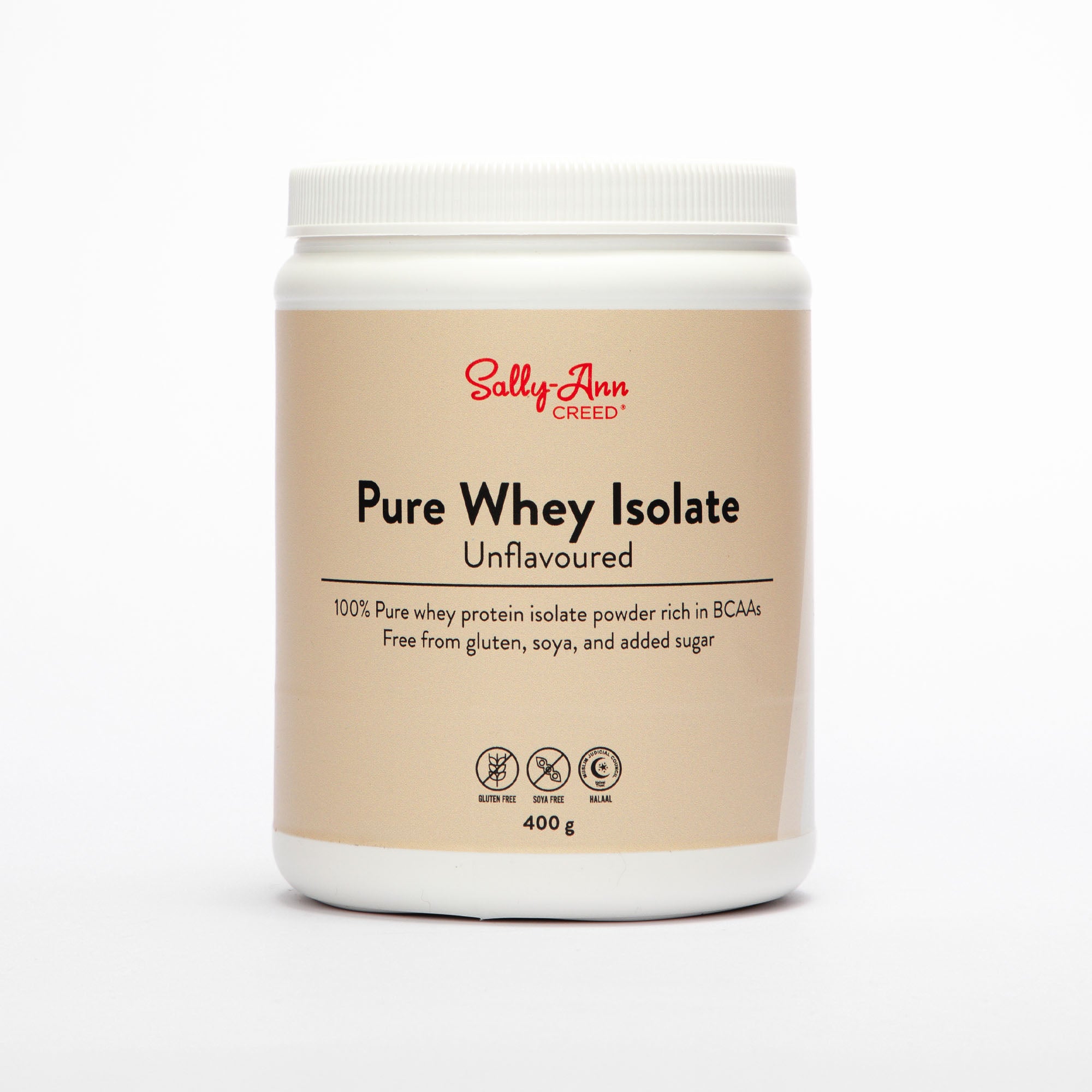
At Sally-Ann Creed®, we only stock Whey Protein Isolate, because we want you to get the highest quality protein source without any unnecessary extras. If lactose is an issue for you, or you are simply looking for the cleanest option, isolate is your friend.
Collagen
Here is a lovely fact most people do not know. Collagen is actually the most abundant protein in your body. It makes up roughly 30% of your total body protein, right now. It is the structural scaffolding that holds your skin together, cushions your joints, strengthens your bones, and gives shape to your tendons, ligaments, hair, and nails.
Your body makes its own collagen all the time. But from around your mid-twenties, this natural production begins to slow. By your fifties, you may be producing significantly less collagen than you did in your twenties. This is one of the reasons skin, joints, and hair often start to feel different as we age.
A few fun facts about collagen:
- Collagen is typically extracted from bovine (cow), marine (fish), or chicken sources. It is not a complete protein and does not contain all 9 essential amino acids.
- It is naturally very high in three amino acids: glycine, proline, and hydroxyproline. These are the building blocks of connective tissue.
- Collagen supplements are typically hydrolysed, meaning the protein has been broken down into smaller pieces called peptides, which are easier for the body to absorb.
Whey vs collagen at a glance
A quick side-by-side, so you can see the differences at a glance:
| Feature | Whey Protein | Collagen |
|---|---|---|
| Made from | Milk (whey portion of cheese-making) | Bovine, marine, or chicken sources |
| Complete protein? | Yes, all 9 essential amino acids | No, missing tryptophan amino acid |
| Key amino acids | BCAAs, especially leucine | Glycine, proline, and hydroxyproline |
| Main role | Building and repairing muscle | Structural support (skin, joints, bones) |
| Best for | Muscle support, preventing age-related muscle loss, balancing meals | Skin, joints, hair, nails, connective tissue |
| When to take | Post-workout or as a meal protein top-up | Any time, often with coffee in the morning |
The amino acid difference
If you want to see just how different these two proteins really are, have a look at the building blocks or amino acids. This chart shows the amino acid content of both proteins, side by side, in grams per 100g of protein.

- Whey's main pro is leucine. Whey contains around 3.6 times more leucine than collagen. Leucine is the amino acid uniquely responsible for triggering muscle protein synthesis, which is why whey is the tool for muscle building.
- Collagen's pros are glycine, proline, and hydroxyproline. Together these three amino acids make up nearly half of collagen's entire structure. They are the building blocks of the connective tissue that keeps your skin, joints, and bones strong.
- Collagen contains no tryptophan. This is one of the 9 essential amino acids, which is why collagen is technically an incomplete protein.
- Hydroxyproline is unique to collagen. It is barely found anywhere else in nature. Which is why nothing else quite does what collagen does for connective tissue.
Which should you choose?
Choose whey if:
- You are looking to build or preserve muscle
- You are training regularly, especially strength training
- You are over 50 and want to protect against age-related muscle loss (sarcopenia)
- You are looking for a high-protein snack or breakfast supplement
- You want a complete protein that fills nutritional gaps
Choose collagen if:
- You are focused on skin health, elasticity, or hydration
- You are supporting joint comfort or connective tissue recovery
- You want to support hair, nail, and gut lining health
- You are over 25 and want to top up what your body is starting to produce less of
Choose both if:
You want the full broad benefit of muscle support, connective tissue support, as well as hair, skin, and nails support.
Nothing about these two proteins competes or conflicts—they complement each other. Whey protein and collagen are two very different proteins, doing two very different jobs. Framing them as rivals misses the point.
They are not competitors. They are complements.
At Sally-Ann Creed®, we offer both because we believe both matter. Our whey protein isolate for the muscle-building, complete-protein side of the equation. Our collagen for the skin, joint, hair, and connective tissue side.
Explore our range:
If you have any questions or want to learn more, please contact our dietitian at dietitian@sallyanncreed.co.za ♥
This article is for educational purposes only and is not intended to diagnose, treat, or replace medical advice. If you have any concerns about protein intake, are managing a medical condition, or are pregnant or breastfeeding, please consult a qualified healthcare practitioner before starting any new supplement.