Articles


Learn all about adrenal fatigue
You’ve probably heard the term ‘adrenal fatigue’ before. It’s used by some health practitioners to describe a syndrome (or group of symptoms) brought on by overworked and fatigued adrenal glands. Although the term has become more widely used in recent years, it’s currently not a medically accepted diagnosis. Here’s a closer look at this somewhat contentious syndrome – what causes it, the signs and symptoms, and what you can do if you suspect you’re experiencing some degree of it. First things first: what do your adrenal glands do? These two small triangular-shape glands that are located on top of your kidneys. These glands are well-known for secreting the stress hormones adrenaline and cortisol – and as Healthline.com explains, they are responsible for producing additional hormones that help your body to burn fat and protein, regulate sugar and blood pressure. What causes adrenal fatigue? As with many other health problems, chronic stress is the culprit. When you experience stress, your body produces and secretes high levels of cortisol. Over a sustained period, this can overload or exhaust your adrenal glands to the point that they no longer produce the cortisol your body needs. What are the signs and symptoms? Cortisol is essential for health and if your body isn’t producing sufficient amounts, you may experience a range of unpleasant symptoms. The signs of adrenal fatigue typically include: Constant tiredness Weight issues Mild to severe depression Low stress tolerance Sleep problems Anxiety or panic attacks Low sex drive Mild to severe brain fog Gut issues An inability to adequately recover from exercise What can you do? If you think you’re experiencing adrenal fatigue, the following lifestyle changes can help you get back on track. Try to reduce stress. Remove stressors where you can and try to incorporate stress-management strategies into your routine, like yoga, breathing exercises or meditation. Eat healthy, whole foods. Aim for a lower-carbohydrate diet that includes enough protein – protein supports adrenal function – and healthy fats like butter, ghee, coconut oil, olive oil,avocado oil, nuts and seeds,etc Ditch the junk. Avoid processed foods, foods high in sugar and salt. Get enough sleep. Lack of sleep negatively affects your health in a whole host of ways and can exacerbate stress levels, so make sure you get plenty of rest. Consider supplements. Adding the following supplements to your daily routine can be helpful: Vitamin C – supports the adrenal glands and helps to reduce the effects of stress on the body. Magnesium – has a positive effect on mood, sleep quality, and stress responses. Pantothenic acid (vitamin B5) – helps to support healthy adrenal function.
Read more
Quick Tips for Menopause
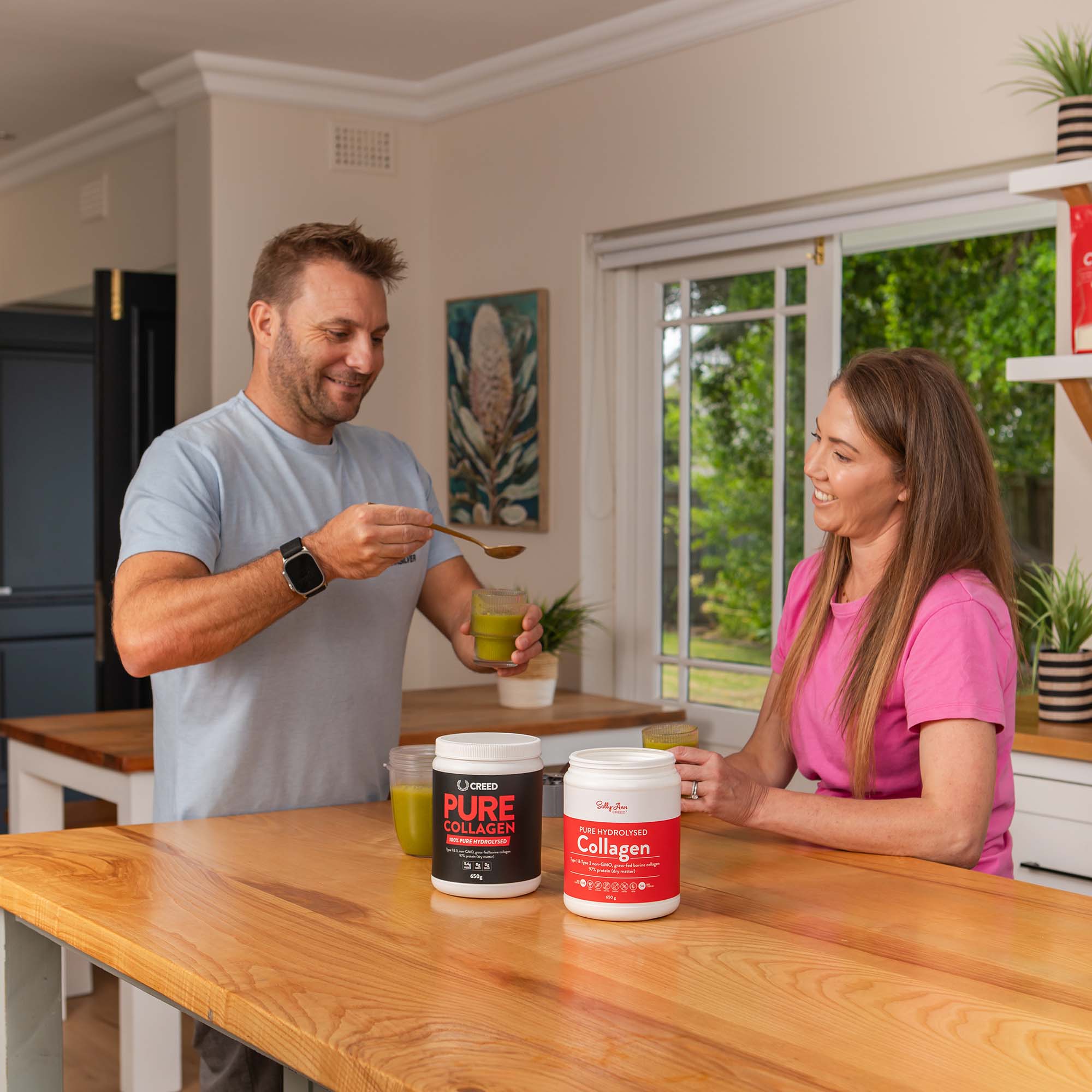
1. MENOPAUSE SYMPTOMS RESPOND TO COLLAGEN Here is some first hand feedback from our customers… “Almost all my menopause symptoms are gone after a few months on the collagen! I only get hot flushes now when I drink alcohol, then it’s my own fault! Lol” JB Hi Sally, FYI…had been taking your Pure Hydrolysed Collagen to assist with my arthritis for 4 months and naturally my pain subsided. But what transpired was the best and most unexpected thing. My menopausal hot flushes disappeared as well. At first I didn’t tie the two together but I had a bad month financially and couldn’t get my collagen and that’s when the hot flushes returned!! Perhaps coincidence? I think not! I have had hot flushes for over 5 years and nothing has helped before this. The fact that they have reappeared after stopping the collagen is what was so interesting. I’m back on the collagen now and will see if the flushes stop again. Hold thumbs!!” KL I have to say I started only this week with your pure collagen and already I noticed a significant difference in the frequency and severity of my hot flashes. Ursula D 2. MENOPAUSE AND YOUR DIGESTIVE SYSTEM Keeping your digestive system working well is another key to good health not only in menopause but throughout your life. Eat organic vegetables where you can, pasture-fed meats and chickens, eggs from pasture-fed chickens and game. Ditch the sugar, alcohol and junk and concentrate on really fresh and healthy foods. 3. MENOPAUSE AND PHYSICAL ACTIVITY Stay active – exercise on its own won’t help you manage your weight but it does help to prevent muscle loss and helps to sensitise insulin. You don’t have to run a marathon or spend all day at the gym. Simply walking every few days or an hour or so is enough. 4. MENOPAUSE AND CHEMICALS Avoid chemicals on your face, when cleaning your home, washing your body and your clothing. Wherever possible, choose natural alternatives to chemicals. Look around your home. You’ll be horrified at how many chemical substances you use every day. 5. MENOPAUSE AND HEALTHY CHOICES Avoid genetically modified foods, avoid man-made fats and oils. Stick to animal fat and olive oil, butter and other healthy fats. You can get all the support you may need and embark on a ‘food journey’ through the 63 Days to Optimum Health Book. You will be guided over the course of 9 weeks to transition in your emotions, food intake and habits to create a new you. Hopefully (if you want to) you will lose weight, feel heaps better, and continue to apply these principles indefinitely. This book is for anyone seeking to ‘create health’ or maintain it. This comprehensive guide offers sections on gut heath, market place myths, substitutions for unhealthy old favourites, superfoods that improve immunity and nourish the body, and delicious, cook-from-scratch recipes that celebrate the benefits of making whole foods at home. By making informed choices, you can enjoy day-long energy and ongoing health.
Read more
Fitness training that suits your body!
Fitness is not a one size fits all topic and we all have our own preferences when it comes to staying fit. There are several different styles of training which one can use to achieve their personal fitness goals and most people choose to stick to the one they most enjoy. Here are different types of training styles that you can easily incorporate into your lifestyle! As an addition to all the below-mentioned styles, it is worthwhile mentioning that training your balance will also go a long way in improving your daily movements. Your balance is tested when doing strength training but further training for your balance could include practice standing on one leg and if that gets easy, close your eyes, and try it! It may seem easy at first, but it will make trying to wash the other foot in the shower that much easier! Cardiovascular training: This type of training can be defined as any activity that increases your heart rate for a sustained period. The following exercises can be incorporated to develop your aerobic fitness levels: Running Swimming Cycling Rowing Hiking Do all of these at your own pace and slowly build up the intensity of your workouts. It can be as simple as walking for an hour and sometimes alternating with a bit more vigorous exercise for a shorter period. It really all depends on your goals and your current level of fitness, Strength training: Contrary to popular belief, you do not need to only do weight training to develop strength! Any activity that forces your body to work against gravity can make you stronger. These activities could include picking up your children or even carrying the groceries. As previously stated, the key is to work against gravity. A couple of exercises that you can do also include push ups, burpees, pull-ups, and step-ups to name a few. Strength is a relative term as it means something different to each person. Once you figure out what yours, do more of it and there are plenty of options to choose from! Flexibility training: The type of training is arguably one of the most important types of training because muscles that are flexible have less of a chance of getting injured. It is also said that the more flexible and mobile you are, the better you will age and move freely with little aid. The way in which you can improve your mobility and flexibility include dynamic stretches as well as static stretches. Dynamic stretches such as wall running, high knees and hamstring walkouts are all beneficial to improving your flexibility. Static stretches such as a standing quad stretch, hamstring stretch, neck and shoulder stretches should be incorporated into your daily activity. Do the above for just 15 mins every day and you will undoubtedly feel the difference in your movement. We would love to hear more about your personal fitness journeys. If you would like to know more about starting yours, please get in touch!
Read more
How to Lower Hypertension
How many people do you know suffering with this – it’s like an epidemic these days. A healthy blood pressure (BP) level should be around 120-130 over 80. Hypertension is a stealth condition as there are sometimes no obvious symptoms. For that reason it has been called “the silent killer”. I want to tell you first of all HOW to measure your blood pressure. Don’t go darting breathlessly into your doctor’s rooms, sit down and have your blood pressure taken. You have “white coat syndrome” to start with which immediately elevates it. Secondly you should have been sitting quietly and in a relaxed attitude for a good 15-20 minutes prior to the measure being taken. If you have it monitored regularly, always do it at the same time of the day, relax first and then have it done. Perhaps going to your chemist or getting your own home monitor would be more relaxing than the doctor but do monitor it if you are concerned. Hypertension doubles your risk of stroke, heart attack, dementia, kidney failure and blindness – nasty! So here are some ways to lower it or at least address it: Speak to your doctor about any medications you are taking which could possible artificially be elevating BP (cortisone does this and so do many other medications) Are you drinking too much coffee – coffee’s great but too much of a good thing will lead to elevated BP Are you drinking too much alcohol? Alcohol is linked to hypertension – I’ll leave it right there before you get irritated with me…. Are you on hormones? Again, chat to your doctor as often these can elevate BP Some antihistamines and anticonvulsants can do this – maybe your doctor could change your script Increase vegetable intake – don’t cut down on meat and fats which are very healthy, just make sure you are getting a decent amount of fresh vegetables every day. Try to have them at every meal, breakfast included (who said you can’t have veggies at breakfast? Pffft.) Eat more potassium-rich foods like sweet potato, avocado, banana, squash, leafy greens and the odd prune. Lose the seed oils and use olive oil which has been shown to have a healthy effect on BP Take a daily stroll – it’s not necessary to do an entire gym circuit each day, but exercise is important Good quality sleep is a wonderful healer, and some instances of high BP are due to too little sleep. You absolutely have to find a way to manage stress – easier said than done, but find a way Use cinnamon – this is an amazing way to not only lower blood pressure but blood sugar too. It needs to be organic Ceylon cinnamon to work (see my online store) and has other great benefits too. Such as fighting unhealthy gut bacteria and improving metabolic rate. In a study by the Journal of the American College of Nutrition in 2006, they discovered just ½ a teaspoon of cinnamon a day could be enough to lower blood pressure (I stress again organic, or it could be ‘cut’ with cornflour and be cassia which is not real cinnamon but a cheap imitation). You want pure, 100% organic Ceylon – I have an excellent one in my online store. If you eat oatmeal, add it to that, or smoothies, or coffee or sprinkle it onto anything. Really important – omega-3 fish oil – take this daily, and eat plenty of fatty fish too. Co-enzyme Q10 is known for the beneficial effect on blood pressure – take around 120mg a day – it’s heart healthy, gives energy and will help to control BP You really REALLY must stop sugar! And all high carb processed foods like breads and cereals. They just drive up insulin and blood sugar which in turn ramps up blood pressure. Take magnesium citrate – an amazing mineral for lowering BP, helping you sleep and relaxing you You might want to try more vitamin C too – according to Johns Hopkins Medicine, and a study published in Nutrition Journal, supplementing with vitamin C may help to reduce blood pressure. Head on over to my online store here for the above products Disclaimer: You can simply click on the name of each product mentioned above (in bold) and a hyperlink will take you directly to the product for an easy purchase. Originally published on https://www.facebook.com/SallyAnnCreedSA/ in 2020.
Read more
Anatomy of a laugh
ANATOMY OF A LAUGH When we laugh, we engage our entire body in the act. At least 15 different muscles in the face are called into action, along with our respiratory system and other muscle groups. But more importantly, laughter sends serotonin levels soaring in the brain, erasing mild depression in just a few minutes. Give happiness levels a boost The quickest way to feel better is to get moving. A brisk walk can get endorphins flowing, giving you the same feel-good boost as a shot of morphine, without the risk of drug addiction. Exercise helps you manage pain better and helps you sleep better Spread your happiness. Your happy emotions can affect others, make the people close to you happier – and make the people close to them happier. Surround yourself with positive people to remain positive too. Fake it until you make it. If you act happy, people see you as happy, and you see yourself through their eyes. You feel happy. Start with a smile to help you break free of the doldrums.
Read more
Burning Mouth Syndrome (BMS)
BURNING MOUTH SYNDROME is a distressing condition that is all too common. Your mouth feels as though you have had a big gulp of boiling water and scalded your tongue and lips, gums, palate and/or throat or all of the above. It can appear out of the blue, develop over time or come and go. Some of the conditions which are linked to this include diabetes, allergies, candida overgrowth, acid reflux, thyroid conditions, menopause or medication. It also seems to be not too bad in the morning, and then get worse as the day progresses. Some of the symptoms include: Pain Increased thirst Changes in, or loss of taste Metallic taste in mouth that remains even after eating or brushing teeth Burning sensation in one or more areas of the mouth RISK FACTORS While this can happen spontaneously, some common medical conditions that can cause BMS include: Sjogren’s Syndrome Radiation therapy Chemotherapy Low blood pressure medications Vitamin B deficiency Iron deficiency Acid reflux Diabetes Thyroid problems Fungal infection in the mouth Allergic reactions to dyes, foods, toothpaste, fragrances or environmental elements OTHER RISK FACTORS YOU MIGHT CONSIDER: Being female Postmenopausal Over the age of 50 Dry mouth A recent illness New medication A recent traumatic life event Elevated stress levels Conventional therapy is merely giving salivary replacement products and various drugs, many with side effects. Here are a few things we have found to have helped people we’ve dealt with: VITAMIN B12 UNDER THE TONGUE: one of the main nutrient deficiencies which can cause this is Vitamin B12, and more than 50% of people with BMS had high homocysteine levels due to B12 deficiency. B12 reduces homocysteine, and in most cases will eliminate BMS. In addition to this, make sure you eat more beef, liver, wild-caught salmon, sardines and mackerel to boost your levels. Take B12 for around 8 months, then see how you go without it after that. It will take a little while to work. IRON RICH FOODS: sometimes in addition to a B12 deficiency – or because of low B12 – your iron stores will be low. Don’t ever take iron unless you have a blood test!! Too much iron is more dangerous than too little – but you can eat iron-rich foods like: organic beef liver, grass-fed beef, sardines, and other animal products for heme-iron (the most important one). Non-heme iron although poorly absorbed and not the same as animal-derived iron, can be obtained from spinach, pistachios and raisins. ZINC: a deficiency in zinc is also a cause of BMS, and this deficiency is widespread. Some signs of deficiency are a weak immune system, diarrhoea, allergies, thinning hair, leaky gut and acne. Zinc-rich foods include: pumpkin seeds, grass-fed beef (very nice source), cashews, cocoa powder and kefir.
Read more